Saturday, May 26, 2012

Sri Lankan Transport – by Vicki


Transport in Sri Lanka comes in many shapes and sizes, they vary from plain to colourful and some are highly accessorised. Most vehicles have horns that are frequently used. Speed is not a determining factor in choice of transport given that the maximum speed limit is 60km, except on the nations single tollway where the limit is 110km.

Buses
Buses are kings of the roads. Buses are the most common mode of transport in the urban fringe, outside towns and in rural areas - they are large, arthritic old rust-buckets, cheap, noisy and often very crowded. They toot as they are about to pass, heading for any gap in the traffic...watch-out!

A miss is as good as a mile!

Tuk-tuks
Short trips in cities, towns and villages are usually undertaken in tuk-tuks. These three wheeled vehicles are made in India and are mostly red, green or black. We had fun tuk-tuk spotting and also saw florescent green, blue, yellow, orange, metallic pink, purple, beige, white and turquoise. Tuk-tuk spotting also extended to accessories and adornments, such as: florescent stickers and slogans; flowers; coloured LED lights; multiple mirrors; boom boxes; twirly chrome handholds and driver barriers; and roof racks carrying surfboards.

There is no limit to the number of people a tuk-tuk will carry – arms and legs inside please. Our family used them for city shopping and even a day tour around Galle’s main roads, back and side roads. We found them convenient and fun and enjoyed weaving through the traffic and (sometimes) up streets the wrong way. They are amazingly strong – toting four of us and our driver up some short steep hills. Prices for a tuk-tuk are negotiated, by the kilometre or by the hour. In Galle we generally used the same tuk-tuk driver and paid 400Rs per hour.

In every town or village tuk-tuks will line up, competing for fares. Major events like the England versus Sri Lanka Test Match (March 2012) saw the tuk-tuks lined up two and three deep encircling the cricket ground.


Move it, move it.
Trucks in Sri Lanka fall into two categories – modern monochrome or those that are older and individualised. Rural transport carriers with their box sides provide multiple surfaces for artistic expression – colour dominates and also utilises the company name in the design. We enjoyed seeing these slow trucks on our travels across the lowlands and highlands of Sri Lanka.

One of the more unusual transport carriers, though common in Sri Lanka, were the cultivator front-ends with trailers. These small machines could haul large loads of rice – we marvelled at how large some were. These carriers could also be seen in urban areas and in rural environs.


- - -


TEA - A Report by Zeke


Monday, April 9, 2012

Gary: Sri Lanka


A signature Sri Lankan animal – the hooded cobra.  They really hiss too!  Sri Lanka has something like 87 snake species, and many are highly venemous.  The nation suffers more deaths from snake bite, per capita, than any other.  And yes this photo was taken with our camera.

We always make an effort to understand something of the countries we visit, even if it is a very superficial appreciation.  National characters, if indeed they exist at all, are neccesarily complex.  And never more so than with Sri Lanka – the most amazingly complex country we’ve ever visited.

A trivial but perhaps insightful example of us getting acquainted with Sri Lanka grew out of three simple tasks I needed to do while in the Port of Galle, viz:

  • take our old 4hp Mercury to an outboard mechanic for repairs
  • take an even older hand cranked Singer to a sewing machine mechanic for repairs
  • take some plastic jerry cans out to the local servo for refilling with diesel fuel.

The Port of Galle from Mojombo’s deck.  
 It’s a busy working port.    
The port is under the control of various arms of the Sri Lankan bureaucracy including (but certainly not limited to) the navy, police, customs, harbour master and port security service.  Visiting yachts require an agent to negotiate its minefield like complexity.  

To undertake my three tasks our agent first prepared a letter (shown below), which he circulated for approval with four separate government departments in the port.  The outboard, sewing machine and jerries, along with the letter, then had to be thoroughly scrutinized and discussed by all parties while departing and later returning to the port.  To expedite matters eight copies of the letter were handed out to the various officials, including the two sequential boom gates, manned by seperate departments at the port entrance.


The letter, signed by four government departments, authorizing me to take an old outboard, sewing machine and plastic containers out of the Port of Galle.

The goods aboard our agents vehicle, returning to the port with me
in the cab clutching spare a copy of the letter.  Our agent has
stepped out the cab to negotiate with boom gate staff.

This whole process could however have been easily short cut had I chosen a different path.  Payment of a small bribe or two to the right officials would have truncated the process to minutes instead of days. It’s mind boggling wondering how a country can function when saddled with such a heavy, lazy, complex, inept and corrupt civil service.  But deeper insights yet were available.


One of the reasons for the Galle bureaucracy’s preoccupation with port security (and its fatness and laziness) is that it is only a few short years since the country emerged from a long and bloody civil war – when it really needed lots of tight security at its ports.  This war was fought between the dominant Sinhalese and a group of militant Tamils in the north, very roughly characterized as follows:
  • Sinhalese make up 74% of the nation’s population, consider themselves ‘native’ Sri Lankans, are primarily Budhists, speak Sinhala, and first arrived from northern India about 500BC.
  • Tamils make up 18% of the population, are Hindus, speak the Tamil language, and arrived from southern India right through from prehistoric times to the English tea plantation era, when large numbers were brought in as field labourers.

While officially the war started in 1983 and ended in 2009, it is a conflict that has its roots buried in literally thousands of years of history, migration and conflict with its closest neighbour, India.  Each side in the war claims underdog status and dreadful atrocities litter both camps.  Many consider it will be close to a miracle if a lasting peace emerges.  The pot was well stirred during the colonial era, which drew to a close in 1948, leaving among other things the legacy of a huge tea industry, the world’s largest (and best known!), and by far the country’s biggest export earner – but equally an industry dominated by issues of equity, caste and ethnicity.

The tea plantations back then were large land holdings spreading across the country’s best, most fertile soils.  They were largely owned and managed by companies and individuals from England. They, along with the large rubber and coconut plantations had been created through the massive displacement of Sinhalese rural peasants – leaving a miasma of simmering discontent.  To address the issue during the 1970s the government nationalized the big estates, redistributing the land from some while managing others as government cooperatives.  This wonderful socialist experiment predictably failed, and much of the industry has subsequently been returned to private ownership following the collapse of tea yields, quality and market share (and hence export earnings).

Morning mist hangs over a highland tea plantation 


Top left: Tamil tea pluckers hard at work.  Bottom right:  the pucker sahib ‘Hill Club’ in Nuwara Eliya, where the colonial ‘planters’ spent many a pleasant evening.

The socialist leanings of the country - Sri Lanka is officially known as the Democratic Socialist Republic of Sri Lanka - also does much to further account for the enormous, unproductive civil service.  Being pathetically paid (the service is too large to be otherwise), civil servants frequently feel forced to resort to corruption, and are often just following the example of their political masters.  The seeds of this corruption have sewn themselves deep into Sri Lankan society creating a citizenry that often seems tightly focused on whatever advantages they can accrue to themselves and their direct dependents, especially when dealing with foreign tourists.

But if these impressions sound overly negative they sell the country way short.  Sri Lanka is an amazing place.

People of Sri Lanka

It is fertile, lush, and green. The lowlands are steamy hot, the highlands refreshingly cool and mist shrouded.  In places it is overflowing with wildlife.  It is one of the few places left on the planet where you can still see a leopard in the wild – we did.  Wild elephants roam its national parks, blue whales swim just off-shore.  It’s a bird watchers paradise.

Wild elephants roaming in one of the nations excellent, seemingly well managed national parks


The amazing biodiversity of Sri Lanka

Steeped in ancient culture, the remains of magnificent ancient cities, some dating back well before the birth of Christ are on display at several UNESCO listed World Heritage Sites.  Intact colonial architecture litters the country.

Spectacular Sigiriya – the Lion Rock.  A 5th century fortress palace blending astonishing works of architecture, landscape architecture, engineering and art. A World Heritage Site.

Galle Fort:  A largely intact colonial cityscape left by the Dutch and English – another World Heritage Site.

The country is awash with a colourful parade of humanity practicing a wide range of traditional pursuits, many little changed for hundreds of years: rice farmers, oxen drivers, smithies, tailors, fishermen, gem miners, and gem cutters and polishers.


Oxen drivers!


Bringing in the rice harvest for threshing


Gem cutter


Stilt fisherman


Sri Lanka can be a difficult and sometimes tiresome place to visit, especially if you’re a yachtee, but we found the effort paid big dividends.


Sunday, March 25, 2012

Nina: Our trip through half of SriLanka

by Nina
Introduction
We started on the 13th of March at eight o’clock in the morning. We did the trip with some friends called Anne and Barry. In this story I am going to tell you all about Sri Lanka, such as Dondra Heads light house is scarily high, there are lots of wild animals in Yala National Park, Little Adams Peak has a fabulous view, and the Ella train ride is well worth it.


Day 1
We left Galle and started to drive. We stopped at a few places that day but my favorite place was Dondra Heads Light House. It was really fun and really scary. You climb up a spiral stare case in the center with curved doors going off to rooms. The gallery was very high, the light house was the tallest in South East Asia. It is the southern most point in Sri Lanka.

Dondra Head Light House and the three hundred year old curved oak door.

The hotel we stayed in had a pool. It was in a town called Debarawewal.


Day 2
We left the hotel at 5.30am to  go on a safari through Yala National Park. It was really amazing. The first wild animal we saw was an elephant’s butt. We saw lots of peacocks and we saw a leopard which was really amazing but it was a long way away. We saw lots of birds. We got back to the hotel at 11.30 to have breakfast, I was hungry!

An elephant’s butt and a superb peacock on display in Yala National Park.

We drove up into the highlands. We climbed Little Adams Peak, the view was amazing. The mist rolled in and out.  Once we couldn’t see any thing except the peak we were standing on.

We stayed that night in Haputale in a really nice hotel. It had a rock in the corner (a boulder).

Day 3
We got up and had breakfast and  had a walk around town and then we got on a train. The train was really cool, it didn’t have seats, all it had were benches. You could stick your head out of the window, it was awesome. There was a fabulous view. We got off the train at Nanu-Oya.

The train ride through the highlands!

We spent the night at Nuwara Eliya.


Day 4
We started driving down to the low lands. We stopped at a tea plantation and a batik factory along the way. We got to Kandy early in the afternoon and had a look at a university. We went back to the hotel and played a dice game. Then we went out to the cultural dance. The women and men were really good dancers. It was fabulous!

The dancers in Kandy were fabulous

We spent the night in Kandy.


Day 5
We left Kandy and drove for a little while then I went on an elephant ride it was really fun and I enjoyed it a lot. The elephant swings side to side as it walks. Then we went to Sigiriya next.

Me on my elephant named Kumari

 Sigiriya is a really big rock in the middle of no where. It had a beautiful lot of gardens out the front and a stair case up the rock. It was made in 500 AD. On top of the rock you can still see the foundations of the palace, it was really cool!

Sigiriya is enourmous and we climbed all the way to the top.

Day 6
We got up and had breakfast and then we went to Polononaruwa. Polonnaruwa is an ancient city of Sri Lanka.  All you can see now are the ruins now. The king’s palace was very big. It was 7 stories high. Only two are left, 5 stories were made of wood but the other two are made of brick. There were lots of temples in the city and a lot of stupas. After we had lunch and went to the hotel. We were really hot and tired!

This is Zeke and I and my best friend, stupa.

Day 7
We got up at 7.30am and had breakfast. We started to drive 8.00am we stopped at Dambulla it  is an enormous lot of caves.  There are 5 right next to each other they all have lots of Buddha statues in them. After we drove all the way home.

This picture is very old, maybe 2500 years old!


Conclusion
I learned a lot on the trip such as an elephant sways a lot when it walks, and climbing Sigiriya is very tiring


Wednesday, March 21, 2012

Our Sri Lankan Train Trip

In Sri Lanka we stayed in Galle Harbour - really the only place foreign yachts are permitted to visit.  From Galle we made a seven day trip in to the hinterland.  It was a fascinating experience.  Below is a little photo-story of a train trip we made in the highlands. I think you will need a reasonably fast connection to watch it (It doesn't work for us!).


Sunday, March 4, 2012

Phang Nga Bay

Phang Nga (pronounced fang nar) Bay is a 400 km² bay lying between the island of Phuket and the mainland of the Malay Peninsula.  An extensive section of the bay is protected as the Ao Phang Nga National Park (Phang Nga Bay Marine National Park) and is also a designated Ramsar Site (a wetland of international significance). The bay is shallow and dotted with 42 islands.  The 3m plus tidal range gives rise to large intertidal zones including forested wetlands supporting 28 species of mangroves.  At least 88 bird species have been recorded in the marine park.  Seagrass beds and coral reefs are also present. Many animals of conservation significance inhabit the park including dugongs, and species of gibbon, goat-antelope, and porpoise.

Location map of Phang Nga Bay

 Some of the 42 islands (limestone stacks) which dot the bay.

Phang Nga Bay’s limestone geology has created many common ‘dissolution’ landforms like sink holes and caves with stalactites, stalagmites and flow-stone.  These amazing overhanging cliffs with pendulous stalactites are quite scary to paddle under – but it’s nice and shady!

Large caverns within many of the bay’s islands have caved in from the top, creating sink holes or ‘Hongs’ as the Thais call them.  They are often accessible from the sea via cave tunnels such as this one.  The unique shady, moist environment within these sink holes provides habitat for many rare and endangered plant species.

Within the bay are several traditional Islamic stilt fishing villages, home to ‘sea gypsies’, descendents of a tribe who fled civil strife in Indonesia perhaps three centuries ago. This one is on the southern end of Koh Yoh Yai.

This ‘sea gypsy’ village, Koh Pan Yee, has managed to place itself on the tourist map – and enjoys far greater economic success than it ever managed to from fishing.


photogenic huh?

We had a bit of an idea from a guidebook where these were, but eagle-eye Nina was the first to spot them as we paddled along under seacliff overhangs in our dinghy.  These rock-paintings are thought to be many thousands of years old – depicting fish, porpoise, turtle and the locally extinct crocodile.

This could be the most photographed limestone stack in the world –  lying within the lagoon of ‘James Bond Island’ it is visited by thousands daily – we tried to get to places like this very early or late in the day.


House of a park ranger- not a bad spot. 


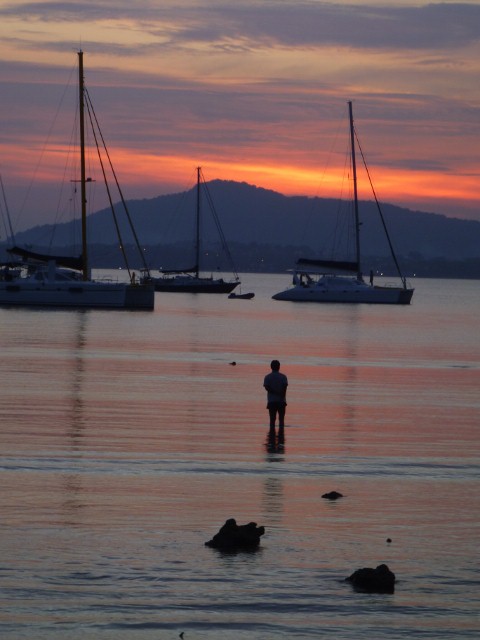
Sunset over boats on the bay!

Thailand - a country rich in contradictions

Thailand has a woman prime minister!  According to Business Report Thailand 30% of Thailand’s CEOs are women and 45% of senior managerial positions are held by women. – the highest respective proportions in the world by a long chalk!

Thailand’s Prime Minister Yingluck Shiniwatra 


But this remarkable female participation rate is apparently largely the result of Thailand’s dynastic society, still dominated by an inner circle of rich, and, it would seem, self interested, families. Prime Minister Yingluck Shiniwatra was the CEO of two large family firms before her election. She is the sister of disgraced former prime minister, Taksin Shinawatra, and is accused of being his puppet.  In one instance of self interest Taksin’s family sold telecommunication shares for a tax free profit of US$1.9 billion after directing legislative changes exempting such shares from capital gains tax!.

In fact the commoditization of women in Thai society has a long tradition.  Before polygamy was outlawed Thai kings routinely kept harems.  Families seeking to develop ties with the royal family would actively lobby to place their daughters in the royal household.  Rama V (1868-1910) had 77 children by 40 mothers and Rama III is said to have accumulated 242 wives and consorts.

During the Vietnam War era the US established large military bases in the country and Bangkok became a favoured R&R destination – entrenching a modern ‘entertainment’ industry that still flourishes.  An industry in which it is estimated a staggering 9% of the country’s female population (including children) continues to participate (Business Report Thailand Feb 2012 pg 17)!

The girls really are lovely – they always made a fuss of Nina as we walked by on the way to the supermarket.  
Thai’s are nearly all Buddhists and enjoy a worldwide reputation for peacefulness and accommodation.  Absolute monarchy ended in 1932 with the adoption of a constitutional monarchy based on the British model.  It all sounds good - but political instability has become the status quo.  There have been at least 19 coup attempts since 1932, many bloody and violent, with eleven successful.  The most recent include the 1991 army seizure of power and the bloodless 2006 deposing of Taksin Shinawatra.  Civil unrest, largely un-noticed by the rest of the world, continues in the country’s south with an estimated 4,000 deaths since 2004 in politically motivated murders and bombings.

Chalong Temple – the most famous of Phuket’s temples – it houses the statue of the highly revered monk Luang Po Cham.  Thais still take their religion seriously and young men are expected to devote a portion of their youth (even if it is just a rainy season) in its service as novice monks.

 The country is one of the wealthiest in SE Asia, but has developed an ‘in your face’ dependency on foreign investment (which really got off the ground during the US/Vietnam occupation).  Phuket bustles with western expatriates, more men than women, but including whole families and many retirees, who reside full, or part-time, on a variety of easily obtainable visas.  On relatively modest incomes they enjoy very comfortable lifestyles.  The upper strata live in large, luxurious, landscapes and pooled houses and units, and all utilize the well resourced and highly affordable western directed services such as medical, dental, optical, educational, plastic surgical and marriage services, not to mention amazingly stocked western style boutique supermarkets (while Thai peasants are currently experiencing rice shortages in the wake of devastating monsoonal floods).  Currently Russians are the top property buyers in Phuket, buying beach resort properties.  The burgeoning Russian middleclass want a ‘beach house abroad’ and Phuket is currently looking like a good deal.

The Thai property boom has little to do with providing affordable housing for the locals!  We understand  though that mostly foreigners are not granted freehold title - a good move I think.
        
Villa Market – soft lighting, mood music and beautiful displays: 5 kinds of apples, Atlantic salmon (from the Atlantic seaboard of Tasmania!), wines of the world and Nina’s favourite – French pastries! 

Thailand is a place of remarkable beauty and international tourism targets this natural wealth.  Currently about 20 million visitors arrive annually (in a country of about 65 million).  But like so much tourism in the third world it has an edge of shame.  At one end of the spectrum, the walled, guarded resorts, secret enclaves of the world’s super wealthy, and at the other end, the ‘flashpackers’ realm, the islands and beaches descended upon by the western world’s twenty-something years old singles, who parachute in from their white collar jobs to surf, dive, rock climb, drink, drug take, dance, flaunt and cavort (all the things they could just as happily do at home) amongst a deeply religious, socially conservative, and often highly impoverished society.

We spent a couple of weeks exploring Phang Nga Bay, it really is gorgeous and largely protected – but tranquility it has not.  From 9 till 5 a continuous stream of tourists in high speed, noisy boats thunder through all the best spots.


Rai Leh Beach, a stunning spot, with many resorts from low key basic to super luxury.  These ‘long-tails’ look beautiful, but are powered by un-silenced 4-cylinder car engines – they can be heard 2kms and more away.

Some of the best rock climbing happens around Rai Leh Beach, apparently attracting young climbers from all over the world.  We spent several hours watching these guys – it was fascinating.