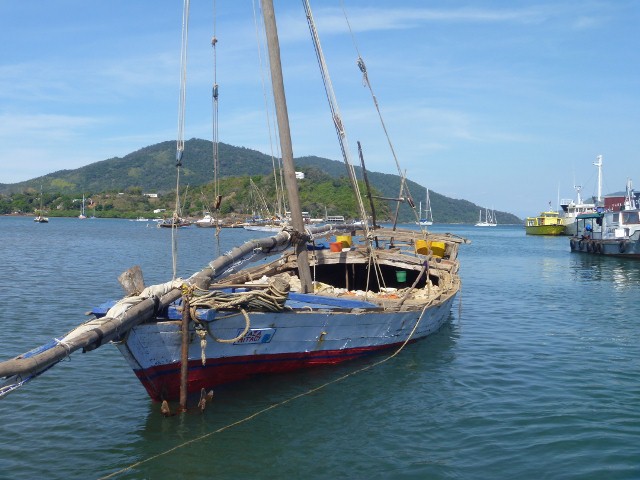
While in Nosy Be’s Crater Bay we tagged along with the crew of Emily Grace on a four-day visit to Ankarana National Park. Ankarana’s 18 thousand hectares encompasses the Ankarana Massif, a high ridge of exposed limestone cut by forested gorges, canyons, caves and underground rivers and surrounded by lower lying areas of light scrub and forest. With such a range of habitats it provides refuge for a wide variety of flora and fauna. We particularly wanted to see lemurs, chameleons and baobabs, and we got ticks on all three, but got to see and learn about much, much more.
Getting there was half the fun, and involved a 6:30 am dinghy trip ashore, a walk into the nearest village, a taxi to the port at Hellville, a power boat ride to the mainland at Ankify, then a 3.5 hr van ride to the park boundary.
At the boundary we walked to our accommodation at Goulam Lodge, and there met our guide Joachim. Joachim assisted us pay our park fees and, as required by law, accompanied us for each of our three day-walks within the park. His wit, intelligence, excellent grasp of English and in-depth knowledge of the park ensured we had a great visit.
 |
| We were off! In Madagascar you can have a taxi to yourself (expensive) – or go ‘collective’ – the cheaper option. No prizes for guessing which way we went. There were ten of us in this tiny car to Hellville!
|
 |
Then we took a high speed ferry (the expensive option this time!) to the
mainland town of Ankify. You can see a man boarding the slow boat carrying
a headboard for a bed – very slow boat when you need to take a bed huh?
|
 |
| At Ankify we boarded one of these vans – normally designed to carry 12 people (4 rows of three) we had 21 of us aboard – but I think that was a pretty light load out of consideration for us foreigners. Luggage, as you can see, goes on top.
|
 |
We stopped for many roadside vendors selling all kinds of regional
specialties including these platters, roasted cashews, dried banana etc, etc.
|
 |
A river bridge had washed out – and while a new one was under construction
traffic was diverted over on this temporary ford. Everybody had to get out
and walk (except us foreigners!).
|
 |
| Villages along the way are meager. They earn some cash by breaking up rock (with a hammer!) to make aggregate for concrete and road construction (see pile of unprocessed rock centre and finished aggregate under tree).
|
 |
Finally in the early afternoon we arrived at the park boundary and our
accommodation for three nights. With Zeke and Nina is Emily – she is
eleven, from Massachusetts, and is a really “neat, swell” kid.
|
 |
Our bungalow! It had a toilet and shower, but no running water (supplied in
buckets from an adjacent well), and had electricity for a couple of hours each night.
|
 |
| Some of the staff, preparing our evening meal on these ubiquitous little steel fabricated fireplaces. |
 |
| Our first foray into the park was made in the late afternoon/early evening of the day of our arrival. Here Joachim (red shirt) is explaining a karst feature – a large sinkhole.
|
 |
As the evening gathered around us we saw our first lemurs. This is the
Crowned Lemur, one of at least 10 species found in the park.
|
 |
| In the twilight we descended into this sinkhole, partially climbing out the other side to enter a bat infested cave with stored human remains (this picture was taken at the cave’s entrance). Included on our ticket was a specific prohibition (a ‘fady’) against engaging in sex in the cave – so we didn’t! |
 |
On the walk back to the lodge we saw this chameleon fast asleep.
By this time we were feeling pretty tired ourselves. |
 |
| The next day we saw lots of chameleons (their skin has three separate layers that can be turned ‘on’ or ‘off’, allowing them to assume a wide range of colours). |
 |
| Madagascar also has many species of geckos. Here are a male and female of ...hmmm the green stripey kind. |
 |
| This was a beauty! – a Leaf Gecko.
|
 |
| We walked up a hill and gazed over the surrounding scrub and forest towards the Ankarana Massif. The areas of bare limestone are known in Madagascar as ‘tsingy’. You can see gorges slicing through the tsingy.
|
 |
| We had an excellent picnic lunch next to this freshwater lake. Lakes are a rare occurrence in this country, this one has crocodiles in it – but we didn’t see any. Otherwise we might have provided them with an excellent picnic lunch. The park is reputed to contain the world’s only cave dwelling crocodiles – but we didn’t see them either. In the background are Tom and Kim (Emily’s parents) along with Simon (our assistant guide).
|
 |
| On our last day in the park we walked to this amazing sinkhole... |
 |
| ... in the wet season three separate rivers plunge their raging waters into it, to travel underground and reemerge on the surface about thirty kilometres away.
|
 |
| Then we left the forest and walked out onto the tsingy. |
 |
It is an amazing landscape, dry, waterless, and full of not dead but
deciduous trees and shrubs. Highly adapted to this environment,
they lose their leaves in the dry season. |
 |
| Just to assure us they weren’t dead, some of the trees were in blossom. |
 |
| There were fascinating smaller plants like this miniature baobab looking thing (although Kim was informed it was something entirely different).
|
 |
| It is a rather inhospitable looking place...
|
 |
| ... but cut by deep, cool, shady gorges.
|
 |
| We crossed one on this bridge!
|
 |
| It was scary (looks terrified doesn’t he?).
|
 |
| Each and every rock of the tsingy has been delicately sculpted. |
 |
| On the way back we passed ‘The Big Baobab’, the largest in the park. |
 |
| ... and finished the day with a picnic, surrounded by lemurs. |
 |
| Go away! |
 |
| This is Vicki’s favourite – just check out that magnificent feather boa of a tail! |
We really want to thank the crew of Emily Grace for having us along – we had a fabulous time!
_ _ _