Thursday, December 12, 2013

Cartagena knockers – by Vicki


Cartagena’s climate and Spanish heritage have given rise to Mediterranean style architecture. In the Old City we see large doors on the street frontage - signatures of wealth and protection. Many of the doors have smaller doors cut into them, some are decorated with rows of raised knobs, and others have ornate door knockers.

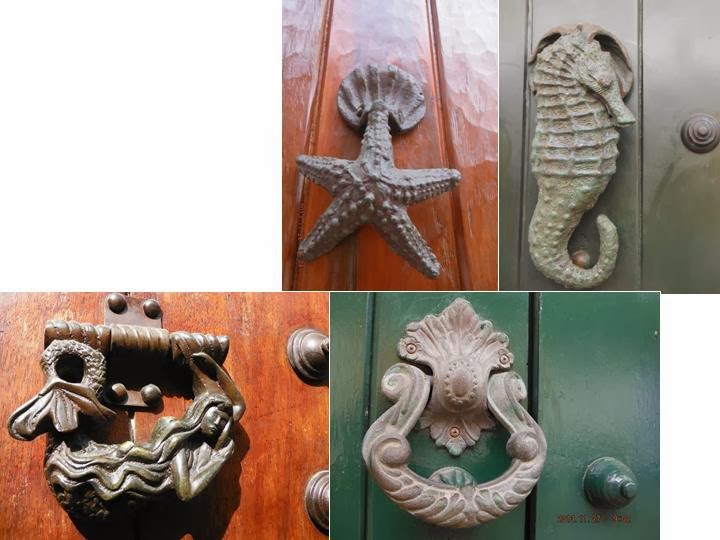
Strolling the streets of the Old City we marveled at the large doors and had lots of fun spotting door knockers.

The doors are heavy and sturdy, personalised with ornate door knockers.


Door knobs and door knockers come in all manner of designs. 


Iguana door knockers are very popular in the renovated Old City.


Lion door knockers come in African, Asian and antique versions.


Water themed door knockers are rarer and more of a challenge for the serious spotter to find. 

My absolute favourite door knocker is the bearded man.

_ _ _

Tuesday, December 10, 2013

Exploring Cartagena, the Old City – by Vicki


Wealthy contemporary Cartagenians prefer to live in high rise apartments

The Old City, a world heritage site, stands pretty much as it stood when Colombia first began its lengthy struggle for independence from Spain (1811). Economic stagnation in many respects “saved” the Old City – few people could afford to make changes and when prosperity finally returned in the 20th century people chose to live elsewhere. It’s a city which reflects the riches of colonial Spain in the 1700s through its churches, housing, and commerce.

Centro and San Diego
The upper and middle class suburbs of Centro and San Diego are where most tourists explore and where the most extensive renovations have been made.

Torre del Reloj or Clock Tower entrance.  The gateways through the fortified
walls provide a sense of arrival, a barrier to the traffic and a great pedestrian
experience around Centro.

Passing through the Torre del Reloj, the first of many fine plaza’s unfolds

The grand old houses of the upper class are two and three storey’s above the street. 

At street level coral stone blocks inset with large heavy doors are all that
can be seen of many houses. 
 
But once across the threshold the true nature of these elegant houses is revealed,
with indoor/outdoor living spaces flexibly connecting themselves to beautiful,
shady landscape courtyards, often featuring the cooling charm of water.


Nowadays many of these houses have been converted to stunning boutique hotels.

Centro has a charm that captivates - street plaques, balconies, narrow lanes. Glimpses of churches rising heaven wards can be seen across roof-tops. Gardens and parks are a refuge from the crowds. Novel street barrows engender a smile. In the evening the buildings reflect a warm glow – shell pink, cream, and ochre - but at midday they are bleached under the intense sun.


Life imitates art, art imitates life.


Getsemani and La Matuna
We also explored the old slum areas of Getsemani and La Matuna, which have their own fortified wall onto the laguna but which sit outside the main fortified wall. Getsemani still remains the poor cousin to Centro and is less visited by the cruise-ship tourist. Our walking route from Mojombo to the Old City took us through Getsemani, provding ample opportunity to explore the lanes and squares. Houses are smaller, mostly one storey. UNESCO dollars have not remade this part of town and a kaleidoscope of colour and stone can appear at any corner.


Manga
Manga, the suburb where we stay has some interesting features for the sharp eye to enjoy. Grand casas are well loved, there are many apartments and relic fortifications, but anti-social activities raise the ire of some.


 _ _ _

Wednesday, December 4, 2013

Exploring Cartagena: Jewel of the Spanish Main – by Vicki


Cartagena is a wonderful city - rich in history, infinitely explorable, a feast of colour and stone. The Old City, a world heritage site, is ringed by stone walls and bastions encasing lanes strung with pastel coloured houses – houses the colour of tumeric, jacaranda, cornflour blue, ochre, shell pink, verdant green, acqua ... and white. Churches are solid, tall and imposing outside but plain inside. Above the street are balconies and bougainvillea. At street level are shop fronts, boutique hotels, cafes and restaurants. On the street are food and drink sellers, teeshirt and hat sellers, and boat loads of tourists. But... watch out for the holes in the footpaths.


Cartagena seems a safe place to explore when the favelas (slums) are far away on the urban fringe. On the street we see Policia at regular intervals day and night. The wealthy are very wealthy and the poor work hard to make ends meet – there is not much in between. Donkeys pulling carts and people with barrows selling fruit and vegetables ply the streets. After dark people search the day’s garbage, little of this penetrates the tourist experience of the Old City.


At the heart of the Old City is tourist oriented gloss. At the periphery Cartogenians experience a different city in over-loaded buses, small yellow taxi’s, and kamikaze motorbike taxis. We enjoy walking through these spaces – tasting food, exploring lanes, and resting in church squares.


We walk along the stone walls seeking to understand how the five rings of defense worked. Land reclamation has filled the mangrove creeks and pushed the foreshore seaward. The series of islands originally settled by the Spanish can only be discerned after some research. The layout of the bastions and fortifications bears no relationship to the present landscape but mostly remains intact.


Stories of conquest abound. First the Spanish conquered the local indian tribes and sent their plunder back to the King of Spain. Next came the pirates and privateers, with some gaining incredible wealth and fame. Then the French and Britain Navy fought the Spanish. All the while malaria and yellow fever, bought to the continent by African slaves, was almost overwhelming everyone.


Statues celebrate key moments in the development of Cartagena – settlement to independence. Alongside this statues of modern art add to the diversity of this amazing city. Museums covering the Inquisition, gold artifacts from indian tribes, naval history, and the history of Cartagena inform and tell the story of Neuvo Granada.


Most days we go forth to explore. Early morning and late afternoon are the best time, when the sun in less intense and the humidity bearable. Some days we follow a theme, other days we explore a small area of the Old City.

_ _ _

Thursday, November 21, 2013

Curacao – by Gary


The Dutch West India Company established shop on this island in the mid 17th century, locating on the Schottegat, an excellent natural harbour.  Willemstad, the new company town quickly developed importance as a trading post, particularly in the lucrative slave trade, and with wealth came the construction of many fine colonial buildings.  During the 18th and 19th centuries the island, like so many valuable ‘possessions’ in the Caribbean, changed hands multiple times between the Dutch, English and French, returning to stable Dutch rule in 1815.

With the abolition of slavery in 1863 the economy languished, only picking up again with the 1914 discovery of vast Venezuelan oil fields.  The Royal Dutch Shell Company, in partnership with the Dutch government, recycled the former slave markets as a major refinery for the South American crude, taking advantage of the island’s deep water harbour and political stability.  New wealth and émigrés poured in to the island.  During WWII with Germany occupying Holland and the US reliant on the flow of Curacao’s oil, Uncle Sam occupied the island.

The white elites of the island attained political independence in 1954 and wealth continued to concentrate in the hands of relatively few.  But by the late 60s increasing awareness of the failure of the black population, the vast majority, to participate at a meaningful level in the island’s wealth brought social instability and riots, resulting in a substantial realignment of political power.  But as always the elites were maneuvering to their best advantage.  By the 80s Royal Dutch Shell, now a major multi-national with bigger fish to fry, had let the island’s refinery infrastructure languish.  It was well below acceptable world standards, dirty, unsafe and producing low grade distillates.  The company, having secured ample return on investment simply walked, giving the refinery to the Curacao government.  But what were they to do with the site?  With few alternatives and reliant on the industry, government leased the site to a Venezuelan oil company, who continue to run the refinery pretty much unchanged.

Today Curacao bears many similarities to Bonaire.  A more-or-less independent country, it falls within the Kingdom of the Netherlands, with the Kingdom retaining responsibility for defense and foreign policy.  The island also retains strong ties with Venezuela (always a difficult bedmate, it’s currently in political, economic and social freefall!). Curacao is relatively flat, dry and environmentally ravished.  In non-urban areas it retains a thin covering of vegetation dominated by prickly acacias and cacti.  Densely populated by multi-lingual humans who speak Dutch, Spanish, Papiamentu (a creole language) and English, their major economic pillars seem to be oil, tourism, various forms of corporate tax evasion and land speculation.

Cruise ship tourism is major.  One day while we were there three ships simultaneously debouched more than 10,000 people into the small city of Willemstad – but they only stay a few hours.

They come for this!  Willemstad is inscribed on the World Heritage List for its remarkable assemblage of colonial architecture built with the wealth of trafficking human beings.


The buildings within the city’s Fort Amsterdam are mostly used for government administration – the Fort Church (detail right) includes a canon ball lodged in its wall courtesy of Captain Bligh, fired from the Bounty.

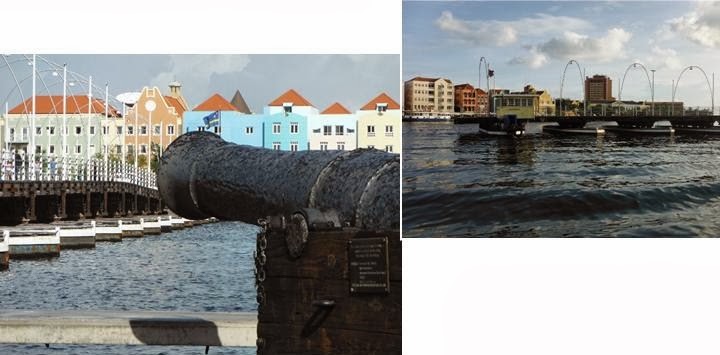
Willemstad straddles the entrance to the Schottegat, a well protected natural harbour.  Pedestrians cross via the amazing Queen Emma Pontoon Bridge, which pivots open and shut to allow ship traffic to pass.  It's shown here shut and opening.

There is also this equally amazing high level vehicle crossing – one of the highest in the Caribbean.

Venezuelan boat people bring fresh vegetables and fish across from their country, setting up colourful floating markets along the edge of the Schottegat.

Deeper in the Schottegat is the refinery.  Pollution remains a major issue but the island is dependent upon oil revenues.

The city is surrounded by fairly humble worker housing – although Curacao enjoys one of the highest standards of living in the Caribbean.


Out further, at Spanish Waters where we kept the boat (bottom right), wealthy Dutch are busy building their dream tropical retreats.


_ _ _

Saturday, November 9, 2013

Bonaire – by Gary


Aruba, Bonaire and Curacao are three tiny Dutch affiliated islands all in a row, collectively known as the ABCs and part of the larger island chain called the Leeward Antilles.  Traveling east from Grenada the first to rise up is Bonaire.  It is hard to imagine an island less like Grenada.  It’s flat, dry and well ... Dutch – it is officially a ‘special municipality’ of that country.  Bonaire’s four economic pillars seem to be tourism, a salt works, a deep water export terminal for Venezuelan oil, and real estate speculation.

Tourism
Tourism is big – the economic mainstay.  Close to half a million cruise passengers are expected to pass through the island this next season, but the fly-ins are more important.  They come mainly for the diving – regarded as some of the world’s best - the waters around the island are crystal clear, the fish life is prolific and the coral is in pretty good condition.  A marine park protects much of this precious habitat and it seems to be actively managed.

Designated dive sites are scattered around the lee side of the island – as you can see the reef drops off dramatically just off-shore.  Divers hire utes to get around.  We snorkeled just about every day – and saw many fish we had not previously seen.


Salt Works
The salt works is an old industry recently revitalized and is surprisingly picturesque.  Salt water pumped into vast shallow lagoons warms up under the scorching sun causing a population explosion of tiny krill so prolific they turn the water pink.  Flamingoes, filter feeders with specially adapted beaks, work the krill while humans and their machines work the salt into export mountains.

A spectacle of pink, white and blue.


These are Greater Flamingoes, they are much more pink than the Lesser Flamingoes we saw in Namibia.


The salt works are old and weren’t always worked by machines – for many years it was a slave industry.  Some of their housing survives.  It is said as many as six people were accommodated in each tiny hut.

Oil Terminal
Venezuela is oil rich, but its waters are shallow.  Bonaire is surrounded by deep water, incredibly close inshore – it’s an anchoring nightmare.  Venezuelan crude, refined into fuel oil, is shipped in small tankers to a depot on Bonaire where it is transferred to large tankers and exported to China.  A recent spill and a significant fire in 2010 highlights the difficulty of maintaining the terminal and a delicate marine reserve side by side.


The oil terminal abuts the island’s surprisingly large Washington Slagbaai National Park.

Real Estate Speculation
Bonaire is officially part of Holland and it has become quite popular as a holiday home/retirement home location for the wealthier Dutch.  New residential development has sent the capital sprawling across the landscape – not that it perhaps matters, the landscape is in such wretched condition anyway.

Wanna buy a bit of paradise?


Around the Island
Together with Brian and Dorothy we made a ‘golf cart’ tour of the island.


Consulting the mud map!

The island’s vegetation is low and shrubby with lots of cacti.  It’s hard to imagine, because everything looks so dry, but prior to the arrival of European’s apparently much of the island was forested.

Europeans first settled in 1526, bringing donkeys, goats, sheep and cattle.

These animals, particularly the sheep and goats, ensured there was no tree replacement – familiar story huh?

But the remaining vegetation provides some interesting scope for fence building.

View in to the Washington Slagbaai National Park.
_ _ _