Monday, September 24, 2012

Madagascar, an Overview - by Gary

Madagascar, the fourth largest island in the world, shares similarities of pre-history to Australia.  That is, with the break up of the super-continent of Gondwana they both floated about in grand isolation, insulated from other large land masses by vast stretches of water.  Consequently the flora and fauna of Madagascar is unique – just as is Australia’s.  But instead of kangaroos, koalas and gum trees Madagascar sports lemurs, chameleons and baobab trees.  The nature here is truly remarkable, although like so many places we have visited, not doing so well, largely on account of us humans.

Two signature Madagascan animals, the chameleon and the lemur 

Compared to continental Africa humans came late, the first settlers arriving from Asia about 2,000 years ago.  They came in canoes, and:

 ‘... began clearing forests and burning them for farmland, and turned lakes and wetlands into rice paddies. Cleared land produced crops for only a few years until the thin soil became sterile. Farmers then moved on to other parts of the forest, in this slash-and-burn agriculture. At some point, African herdsmen colonized the island, bringing zebu cattle, which crowded out wildlife...’
Endangered Species Handbook 2005 

 Zebu cattle are a vital source of protein, as well as being important for transport. 

The humans thrived, and are currently estimated to number over 22 million. This human avalanche has, according to the most recent estimates, carried away about 90% of the forests, including ALL the richest lowland forests (that feature in the cartoon movie!).  The arrival of humans signaled the end of many species, including ‘elephant birds’, two species of pigmy hippos, several large species of lemurs, giant tortoises and many more.

A market in a small village.

But while numerically strong, this human population has also had its share of tribulations.  Its early history includes epochs of brutal leadership and inter-tribal conflict.  The arrival of Europeans hardly improved life, with predation of bodies for slavery and souls for the church, and after an accord with the English fell in a hole, eventual colonization by the French in 1896.  Since gaining independence in 1960, things in Madagascar have mostly gone even further downhill.  Like so many fledgling nations, poor leadership and official corruption has retarded development and kept most of the population in poverty.  No matter which way it is measured, it is one of the world’s poorest countries.

Typical village house in northern Madagascar – life is not real easy for most Malagassy. 

The vicious grip of poverty leaves limited space for a broader view of the island’s natural capital. Much of the island is steep, with very fragile, infertile soils.    Forest clearance, associated reduced rainfall, loss of soil structure and sterility has resulted in major erosion issues.  Much of the central highlands has already been reduced to bare earth, pocketed and gouged by deep gullies and cavernous holes.

Soil erosion on a grand scale.  Gradual abuse of these soils has been leading the nation ever closer towards the brink of ecological collapse.

However by 1985 the world (and many Madagascans) had come to recognize the importance of turning things around, both for humans and for nature:

‘Its fauna and flora represent many extremely unusual and unique examples of evolution .... This island is considered one of the five most biologically important areas in the world; its primates are the world's highest priority for conservation ...’
Endangered Species Handbook 2005

Thus starting around 1985 Madagascar, with considerable overseas assistance, has created a protected area system totaling 47 reserves including two marine reserves.  The system seeks to gather the best Malagasy natural sites sheltering representative species of ecosystems and providing habitat for numerous endemics that require specific conservation measures.  While not without some major ongoing management problems it is already an impressive accomplishment for so poor a country – and there are apparently still more plans for reservation in the pipeline.  Despite these prodigious efforts many, many species remain endangered.

We visited Ankarana National Park – one of 19 national parks

However, while nature is looking a bit more secure, the island’s humanity is still not faring much better.  Like so many third-world countries, freshly independent Madagascar had an unsuccessful fling with socialism/communism – leading to a massive withdrawal of expatriate French expertise and investment.  Reinvigorating a market economy has been difficult, although some recent oil and mineral finds and the write-off of some large loans by the World Bank are considered encouraging, while a fledgling tourism industry is enjoying some success.

However political instability and corruption remain major issues.  A democratically elected government was, in 2009, toppled in a military backed coup d'etat and the situation in the capital is still reported as ‘tense’.  Despite efforts by the UN and World Bank and other ‘honest brokers’ to map a path back towards democracy, fresh elections have still not been held.  The continuing political uncertainty stifles investment and growth – and scares away the tourists.

It would seem that Madagascar’s future still hangs in the balance....

Madagascar’s famous baobab avenue.

_ _ _

Sunday, September 23, 2012

Reunion Volcano - by Zeke and Nina

Below is a photostory that Zeke and Nina put together - telling all about their trip up Reunion's still active volcano.


They also did science reports as part of their school work, these are attached below:

Reunion Architecture – by Vicki

The French colonial and Creole architecture of Reunion was both a disappointment and a delight. A disappointment because the guide book lauded ‘Villages Creoles’, whilst having a distinctly French ambience, were hardly different from other housing in Reunion.  One exception to this was Hellbourg in Cirque Salazie. The island's capital, St Denis, was an absolute delight.

Hellbourg
The architectural style of Hellbourg was French colonial – pressed metal ginger-bread strips along roof edges, verandahs, French windows, and wooden shutters – all highlighted with bold colours. This style was represented in the housing and hotels.

Hellbourg houses

Hellbourg hotel

Public buildings like the library were maintained and still in use.

Hellbourg’s public library

St Denis
St Denis (Syn Dny) was, for us, an architectural delight – preserving and celebrating its French colonial history. The administrative and shopping precincts have retained and maintained this architectural style accompanied by appropriate street furnishings, statuary and obelisk.

Streetscape

Rooflines, verandas and trims accentuate this statement.

Streetscape two

Another feature of the streetscape were the grand gateways – some stern and formal, others a riot of colour. These gateways provided a glimpse into public and private realms. Some spaces befitting international design and gardening magazines.

Gateways

Commercial properties also utilised the colonial architecture to their advantage – eateries, upmarket restaurants and bars alike use existing buildings in primary locations rather than find themselves pushed to the periphery.

Eateries, up market and down.

_ _ _

Monday, August 13, 2012

The Caldera of Piton des Neiges

A photostory collaboration by Gary, Vicki, Zeke and Nina


Réunion: a little background – by Gary

At 63 kilometres long and 45 wide it is just a speck in the Indian Ocean, but what a speck!  Only 200 kilometres away from its closest neighbour, Mauritius, it shares many similarities to that country, yet at the same time it is remarkably different.

For a start it is French – not just somewhat but totally.  As an overseas department of mainland France it is an integral part of the Republic, it's part of the EEC, its currency is the Euro, and French is the official language.  The main impact of this distinction is that it overflows with wealth and modernity; with wonderful things like highways, roads, bridges, cars, marinas, education, mobile phones, flat screen TVs, welfare payments and traffic jams.  Thanks to the generous flow of Euros from Paris true poverty is pretty much unknown here.

Like Mauritius, it is crowded with people (over 800,000) and has great ethnic diversity, but with a different mix.  Creoles (the descendents of African slaves) make up about 40% of the population, with Indians (descendents of indentured labourers) being 25% and Europeans (whites, mostly originally from France) another 25%, along with small numbers of others, mostly Chinese.  The first language, the lingua franca of most of these folks, is not actually French at all, but Réunion Creole.  While things like education, road signs, shopping, administration, tourism and most media reporting are conducted in French, conversations between family and friends will most likely be had in Creole.  English on the other hand is pretty much a totally unknown language.

The island’s history is similar to Mauritius but with important differences.  Uninhabited by man before the arrival of Europeans, the first colonial settlers in 1642 were French.  It remained a French possession until captured by the English in 1810 (readers of Patrick O’Brien will know it fell slightly before Mauritius) during the Napoleonic Wars.  With France's defeat and surrender in May 1814, and under agreements forged at the Congress of Vienna, the island was returned to the French just five years later in 1815.  It has remained in French hands ever since.  Independence does not seem to be particularly high on the local’s agenda (wonder why???).

Like Mauritius, sugar has been the traditional economic mainstay, and like Mauritius it is this industry that prompted large numbers of slaves to be brought to the island, followed by indentured Indian workers following the abolition of slavery.  These days tourism is also an important part of the economy, but nowhere near as important as in Mauritius.  Practically all tourists arrive from mainland France.

Unlike Mauritius, Réunion retains large tracts of land and fringing reefs with reasonably intact natural values.  Like Mauritius the island is volcanic, but on Réunion one volcano, Piton de la Fournaise, is still active, indeed it is one of the most active and impressive volcanoes in the world.  The island also has a very large inactive volcano, Piton des Neiges.  These two high volcanic peaks and their associated caldera, ridges, valleys and canyons are contained within a stunning national park system that comprises more than 40% of the land area of the island.  Well loved, Réunionnaise use their park system for hiking, picnicing, climbing, sightseeing etc. It is a listed UNESCO World Heritage Site.

Finally, the island’s capital, St Denis, contains an exceptional wealth of well preserved and beautifully presented colonial architecture.

We don’t want to rave about the place, after all its full of damned frogs, but with its natural beauty, its awesome volcano, its walking trails, its camembert and baguettes and its French colonial architecture we reckon Réunion Island has to be one of the Indian Ocean’s best kept secrets.

The marina at St Pierre, looking across the town centre in to the volcanic caldera of Cirque Cilaos, Réunion National Park. 


Standing on the side of Piton de la Fournaise, Réunion’s active volcano, next to a REALLY recent larva flow (2010)

Frozen rock anybody?
  3.

An old colonial hospital in the heart of St Denis, recycled as government offices. 


Streetscape, St Denis


The heart of Réunion’s World Heritage Site, at the foot of Piton des Neiges
 
_ _ _

Sunday, July 29, 2012

A Canon Report, by Gary

In Mauritius canons have a way of inserting themselves into the picture.  Rather like McDonalds in Australia, they are a ubiquitous (but on the whole probably less sinister) presence.

Indispensable items of coastal defense, lots surround the edge of the older, more authentic parts of the Port Louis waterfront... 


... as well as adding the correct historical ambiance to the newly redeveloped parts. 


Visit the old fort above the city and one might reasonably expect to find a canon or two... 


... or here at the Martello Tower in Black River ....
  
...but wandering through the bush???


They really make brilliant play equipment...


 ... are useful decorations for many an historic house... 


... and are good for striking that dramatic pose. 


They are of course vital furnishings for historic ship models. 


But adaptive reuse as fence posts really has to take the cake! Extending for several city blocks in Port Louis is a boulevard of two magnificent parallel islands of Royal Palms.  Starting at the waterfront the boulevard extends to the forecourt of the old Government House (seen here in the background)... 


 ....and the whole lot is fenced with chain, supported by literally hundreds of canons, buried, muzzle skywards and concrete filled.  Fantastic!!!


- - -


Martello Towers – by Zeke

While in Mauritius we visited two martello towers stationed on either side of the bay at Black River.  The towers were built in the 1830’s by the British in case of an invasion from the French. Fortunately this was not necessary and the cannon’s were never fired in anger. We first visited the derelict tower which was in amazingly good condition oh except the floor.


From left to right, Nicola Lara Mum and Nina in front of the derelict Martello Tower 


Climbing up a ladder to the second floor landing.  As you can see at least there’s a ladder .

We left the tower with many questions which were answered at the second tower which had been converted to a museum. The museum was one of the best we visited in Mauritius with a guide per group.

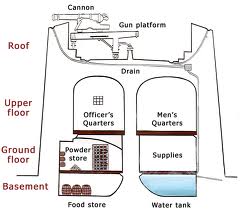
We were impressed by one of the key features of the martello tower which was the stone roof of the powder room was doubled as a inflammable surface in front of the fireplace on the upper floor. Twenty to 25 men lived in this tower around the 1830’s. The cannon which is mounted on a central pivot has a full 360° view of the surrounding shore. The fort not only had a long rang cannon but also a cannonade.

Our Guide in front of the fireplace and above the powder room 

  
In the cross-section picture you can see that the soldiers actually entered the second floor via a ladder then down a rope ladder not shown to the ground floor. The fort was kept well stocked with water and food and could be lived in for many weeks. On the seaward side of the fort the walls were three meters thick and on the opposite side two meters thick. Both the towers had some ground based defense consisting of a cannon and strategically placed mounds of dirt.

Cross-section of a Martello tower 


Martello towers have been built all over the world from Canada to South Africa from Sri Lanka to Jamaica In colder climates Martello towers have been known to have rooves from which forth a cannon can poke.

Hundreds of martello towers have been built by the British around the world wide as you can see in the map above.  

Martello tower with roof            Canada

And surprise!!! There is a martello tower in Australia. Any guesses where it is?

The martello tower in Australia


Some of the many Martello towers around the world. 


 Martello towers are still used to this day, some as houses for those who desire to live in a fort. When I was on web looking for pictures of martello towers I came upon a very interesting site called Napoleon proof your home which talked about how a guy renovated a martello tower and came up with something amazing.

Amazing

ps: The surprise Martello tower is Fort Denison in Sydney Harbour, Australia


Mauritian Friends – by Nina


I had a few friends while I was in Mauritius. The ones I had were very kind (they even chucked my brother in a swimming pool!).  Their names were Nickola and Lara on Flinders Chase, and Tomas, Catharine, Nickolas and Antoine on Cat Mousses.

These are my friends
 One day we went with Lara and Nickola to a haunted house and to a two story Mortello tower that was built in 1847.The haunted house seemed to give everyone the creeps but I didn’t get really scared it was just a house that a guy had gone mad and killed his children and wife and ran away in a boat and killed himself. The Mortello Tower scared me more.

When we played hide and seek tag with Flinders Chase when Lara found us she got really excited and would come after us like a hooligan. Me and Nickola would get scared and run away.

This is Lara.

 We would go ashore and chuck a ball around and have a great time at Black River. Though, with the Cat Mousses it would be a bit rougher. We would chase Tomas and try and get the ball off him.

We climbed to the top of a hill with the Cat Mousses, about a quarter of the way up the hill the boys took a short cut. Catharine took one a little further along the path and I got left behind and I didn’t catch them up till we got to the top and I felt a bit sad. But I went back down with Catherine and we beat the boys down the hill. We sat down and waited for them and when they came we said we had been there for hours. 


This is Catharine. 

Friday, July 13, 2012

Mauritius – Our first African State - by Gary


                                       Mauritius was made first, and then heaven;
                                                                         heaven being copied after Mauritius
Mark Twain
While officially extinct we managed to capture these three unlikely survivors outside the Museum of Natural History. As you can see one was manacled, so it was an easy shot!


History

‘Discovered’ by the Arabs, but unpopulated when the first Europeans arrived, the history of this tiny Indian Ocean dot involves the usual suspects; the Portuguese (didn’t stay), the Dutch (stayed a while) and the English (stayed longest), but with a few new angles for added interest.

1. The French

The Dutch abandoned the island in 1710, making way for the arrival of the French in 1715.  After a slow start they developed a thriving seaport servicing without prejudice the needs of merchantmen, privateers (i.e. pirates) and navies working the SE Asia trade route.

2.   Slavery

The Dutch were the first to bring African slaves to Mauritius, a practice both the French and the English continued.  Plentiful cheap labour was required to work the island’s developing sugar plantations (initially cropped just for rum production to supply visiting ships).  Today people of black African descent make up about 27% of the population.

3. Epic Tall-Ship Naval Battles

The strategic value of the islands for English empire building was too great and after a series of skirmishes in 1810 a fleet of three English ships invaded the east coast port of Marbourg.  A three day pitched battle ensued with the French eventually victorious.  But the English were quick to return, this time in an armada of 70 ships with 15,000 combatants aboard.  French defenses were completely overwhelmed – the English colonial era had begun.

4.   The English Influence (or lack thereof)

Despite almost 160 years of British colonial rule the stamp of mother England upon the local population remains remarkably light.  The speaking of the English language is a past-time usually reserved for certain foreign tourists, notwithstanding it being the official language (parliament is even conducted in French!).  The indelible influences of the English are more subtle but include:

  • the dominant industry – an aerial view of the island reveals a vast monoculture – sugar.  The current technology of large scale sugar production was largely pioneered by British plantationers and industrialists across her colonial realm and this tiny island still ranks as one of the top 10 sugar exporting nations.  It is said that the island’s history is written in sugar.
  • the high percentage of Mauritians of Indian descent (about 68%).  With the abolition of slavery in 1835 the English solved the acute labour shortage in their rapidly developing and highly profitable sugar industry by bringing in Indian indentured labourers – it goes without saying they were treated appallingly and paid peanuts, but they weren’t slaves.
  • the morning cuppa!  Despite the ubiquity of baguettes, camembert and cheek kissing Mauritians still stop for their tea breaks.


The Environment

The nation ranks as a world leader in extinction rates – right up there with Australia.  Famously first to go was the Dodo (the Dutch apparently took care of them), followed by the giant tortoise.  The wholesale clearance of rain forests, frequent firing, development of the sugar monoculture and introduction of a plethora of weed fauna and flora species (including over 1¼ million people) has left scarce room for nature.

Modern Mauritius

Independence arrived late, in 1968.  Perhaps the laggard withdrawal of the Poms was a blessing?  By African standards the nation has become an economic powerhouse!  With a healthy democracy, only moderate levels of corruption, a functional legal system, good health and education standards and high rates of national and international investment, development is proceeding apace. Construction is visible everywhere including infrastructure, civic, commercial and residential building work.  The island supports a huge and bustling tourism sector.

Alas not everybody gets to participate and shanty towns are still in evidence – but for the most part the human population seems to be doing pretty nicely – they’re no dodos that’s for sure!


 Left: entering Pt Louis – an eclectic mix of architecture nestled under a stunning backdrop.
Right: a bit of waterfront revitalisation, Le Caudan shop, hotel and marina precinct


Pt Louis’ equivalent of Hobart’s Salamanca Market.  Mauritius has one of the highest population densities in the world – in urban areas the density reaches 3000 people per square kilometre.


City Market – a bustle and hustle!


Inside – and oh what beautiful produce, and beautifully presented. 


The nation’s Supreme Court precinct, a beautiful colonial oasis. 


 Mauritians are particularly proud of their philatelic history dedicating two separate museums to it (we reckon one would have been quite enough but you never know what you might miss until you go!).  In 1846 the island became the fifth country and first colony to use prepaid stamps.  This is the apparently famous original ‘blue penny’. Only 27 of these Blue and Red “Post Office” Pennies are known to survive – they fetch extraordinarily prices!

Black River (Grande Riviera Noir) is the location of the islands most important national park - nominated as a World Heritage site it provides refuge for many of the islands’ threatened species.

Aldabra Giant Tortoise – a close cousin was once native to Mauritius but these monsters, natives of the Seychelles, were on display in a park.

Faces of the Mauritian sugar industry – old and new.  As you can see, while we were there much of the crop was in flower – Nina and I constantly had runny noses and the sneezes.

A large beam engine - cutting edge British industrial steam technology quickly put to work in the colonies (the classic columns are a nice touch huh?).

Bike riding was more or less safe north of Grande Baie where the coastal scenery was pleasant with views to small offshore islands.

The form, colours and setting of this church, well we thought it was a bit of a bell ringer (ha ha). 


_ _ _

Sunday, June 24, 2012

Mauritian Ship Models - by Gary


Below is an account of our visit to a factory/showroom building historic ship models.  We found it really interesting.